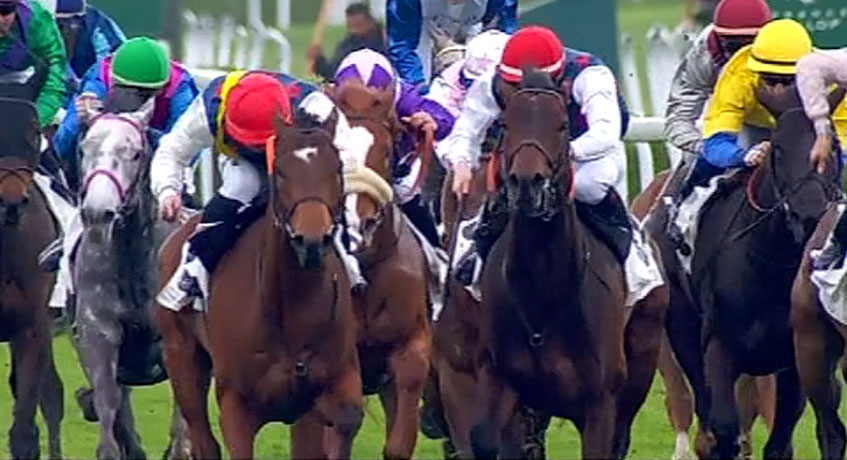
Alright, so now that you’ve familiarized yourself with some racing terms, read an introduction on how to play the races, read the introduction on how to read the daily racing form, and finally learned some basic winning techniques, I thought I’d try the overwhelming challenge of attempting to lay out in simple terms what my own basic handicapping approach looks like.
Before we begin, I do want to impress upon the reader that a simple rule of thoroughbred racing is that for every horseplayer, there’s a slightly different version of handicapping. Actually, some approaches are wildly different. Some folks believe in “systems” that apply mathematical equations in order to predict probability odds against the actual wagering odds. Other players emphasize particular portions of the game such as speed or pace in order to identify winners.
Not long ago, when I first decided to become seriously involved with the sport, I pondered over many theories and tested just about every strategy I could get my hands on. What follows below are what I consider to be tried and true things to consider when handicapping a thoroughbred horse race.
I break my handicapping approach down into 4 major components:
-
Form
-
Pace
-
Conditions
-
Intangibles
I. Form
The first thing I do when looking at a field of horses in a race, whether it be with my own eyes or with a copy of past performances in either the track program or the Daily Racing Form, is to attempt to ascertain a horse’s present form. By form we’re looking for the basic condition of the animal. Is he in the proper shape to run a winning race today, or is now not the time to back him? In my humble opinion, form is the most crucial element of handicapping. There are many clues that can signal the current form that are not too complicated for beginners to understand. Some of the things I attempt answer when looking at the current form of a horse are:
- Is the horse being moved forward confidently, or is he dropping like a rock and/or being offered for a claim for the first time? When a horse drops for a claim, the owner risks losing that horse at the end of the race. Obviously this then dictates that the better horses are not risked in such races and instead compete at the higher Allowance and Stakes levels. Many handicappers rightly realize that a horse does increase his chance to win by dropping to lower level competition, at least theoretically if not practically, but one must also consider that a move by a trainer to enter a horse in a higher level of competition indicates confidence in the horse’s current condition. Confidence is a good sign. If you watch a lot of trainers talk or read their comments, you’ll see they are typically brimming with confidence. Words matter little to an astute horseplayer. Actions are much more indicative of true beliefs. I play a lot of horses dropping in class in my selections, but the really great horses progress from maiden special weight - to allowance - to graded stakes level very quickly.
- How’s the horse been working/racing recently? The rule of thumb for reviewing races is to take the last 3 into the most consideration, but there are some exceptions to this. If a horse is running at a particular distance or on a particular surface that they don’t frequent often then you may need to drill down a bit further in the past performance line to get an idea of how the horse will handle the change. Workouts are very tricky and need to be scrutinized quite closely. Different trainers prefer different styles of working out horses. Some players look fur bullet workouts and only make note of them. I call this the “Bob Baffert angle” as Baffert seldom sends horses to post without a list of sharp, quick workouts. There are other approaches though. What a beginning horseplayer needs to understand is that a trainer only really needs to see talent once, after that he may be prepping the horse so that their best effort occurs on the race track rather than the training track. Pay attention to all the clues you can when reviewing workouts. One angle I really like to see, especially in debut horses, is a workout at a distance longer than today’s race. For example, a horse that has worked out at 7 furlongs but is entered to run today at 6 furlongs. For horses that are more seasoned, a good rule of thumb is that they should be working out or racing about every 3 weeks. If you see prolonged stretches without any racing or workouts, and the horse is entered in for low level claiming race, these might be interpreted as red flag warning signs that something has gone wrong with the horse’s form - and we don’t want horses that are regressing in form.
- Very simply, I mark each horse with an arrow going upward if I feel they are progressing in form, or an arrow downward if I feel they are regressing in form. This doesn’t mean that the downward pointing arrows cannot win, as quite often they will. It just helps me identify who I expect to move forward/backwards and incorporate that information into the selection process. Young horses especially go through wild changes in their form almost on a race by race basis. Older horses tend to be more consistent with their form. Those last two statements are admittedly generalizations but seem to hold true more often than not. Pay close attention to how certain trainers fare with different types of races. Some trainers are aces with 1st or second time starters (meaning their morning workouts are designed to maximize a horse’s chance to “win early”), while other trainers prefer to race their horses into shape. You’ll hear horseplayers say things like “he probably needed that race” when this last scenario occurs.
- When judging with your eyes during the post parade, look for a horse that is not expending a good amount of nervous energy on the track. A brilliantly shiny coat is also a great sign, as are the ears being pointed up in an alert fashion. Warning signs include nervous behavior, excessive kidney sweat, and a dull coat. Like all rules there are exceptions to this. Certain sires tend to bring out a bit of friskiness to their offspring who can act unruly in the gate yet still go off and bring them home. Generally speaking you want your horse to look calm and focused, but not so laid back that he’s disinterested in the race. Ask yourself, does my horse look like a professional race horse, or does he look like he has no idea what he’s doing out there? Now ask yourself which one you are confident wagering money on? It takes years to perfect an eye for horseflesh, and yours truly is not bombastic enough to suggest he has perfected this art, but I have been able to pick out several long-shot winners based on looks alone. Over in our horse racing links and blogroll section, we have links to Ron Correll’s Morning Line blog. Ron has probably the best eye for horseflesh I’ve ever seen, so if you see him writing about an impression a horse has made on him you can consider it gospel as far as I’m concerned. Additionally, if you play along on TVG, one of their announcers is an ex-trainer named Nick Hines who also has a superior eye for horseflesh. I recall one day at the beginning of the Hollywood Park summer meet in 2007 that he was picking winners in the post parade on sight alone in nearly every race……and we weren’t talking about 2/1 favorites either. So, long story short make sure you are at least reviewing with your eyes and noting what you think you see versus what actually happens. Don’t get frustrated, you’ll start to see things stick out soon enough. Just practice, practice, practice!
- Laslty, consider how much the last race may have taken out of an animal. Many players swear by the so-called “bounce” rule that dictates when a horse is likely to bounce back and run a dull effort. One of the many schools of thought on this is that if a horse extends too much energy in a particularly tough race, he may not have a lot left in the tank today. As an example, I thought this perfectly described Street Sense heading into the 2007 Kentucky Derby. I obviously ended up wrong that day, but considering how he was never quite the same again after getting beat in the Preakness 2 weeks later, was it really that far off? On the one hand you want to see horse come back to the track quickly, but on the other hand a little extra rest and or layoff freshening can do much towards boosting a horse in his next endeavor. Remember, this section is all about form. and we’re interested in horses that are in the best from today rather than when they last ran.
II. PACE
I’ll try and keep the pace handicapping section as simple as possible because this is where the folks with the calculators and computer programs come out of the wood-works. I actually keep this pretty simple myself and try and breakdown how the race will be run. To do this, I break the race into 3 categories of horses:
-
Front Runners: These are the horses that need and/or want the lead in a race. These are the horses that quickly move to 1st or 2nd running position as denoted in their past performance running lines and attempt to ”wire the field.” At the various “calls” in their races, you’ll see lots of 1’s and 2’s. Frequently you will see comments as well that they either had the lead or “dueled.” If you spot only one such horse in a race, they are considered one of the easiest bets in the entire sport. If, however, there are multiple such horses in a race they have the tendency to duel each other out, which opens things up for the other two types of runners. The faster the early fractions in a race, the slower the final fractions tend to be. In a perfect situation a front running type horse should be able to establish a clear lead and sit comfortably on top dictating the pace of the race.
-
Pace Pressers/Stalkers: Think of pace pressers and stalkers as horses that harass the front runners and force them to race uncomfortably. Most of the time these horses tend to park themselves just outside the first flight of horses, but they can launch from nearer the middle of the pack as well. These horses make their run somewhere near the final turn and attempt to run down the front runners on the way to the wire. They benefit from a solid pace in front of them, but not something that goes too quick and tires them out as well. I like to think of it as a mildly fast pace being their best friend. You’ll see comments such as “stalked” and “tracked” in the past performances or you may see them referred to as having “tactical speed.” These horses tend to enjoy being parked around 3rd or 4th position as the field begins to turn for home. It may take some time figuring out how to spot these guys as they sometimes prefer to break slow and gradually move there way into position.
-
Closers: Closers are horses that sit anywhere from the middle of the pack on back to the rear and try to make thrilling stretch runs at the end of a race. As such, they need a good amount of pace to run at. If they are entered into a field of predominantly front-running types they should theoretically have their odds boosted. If there is only 1 or perhaps no front running types then they will often have difficulty with the softer fractions they face today. Closers are in my opinion the most exciting type of horse to watch on the track. Seeing a bullet passing other horses to the outside as they close on the wire is one of the more heart-stopping moments of the sport. In my opinion closers seem to prefer a longer stretch of ground to prevail, and I tend to like them more in routes than in sprints, but it’s a mistake to discount them altogether in such races.
III.CONDITIONS
Conditions play a vital role in determining the outcome of horse races. What do we mean by conditions? Well, any number of things really, including: track surface, competition level (class), weather, the distance of today’s race, and any restrictions or specifications that could affect today’s race. When we were assessing form above, we were really focused on the horse itself. Here we step away from the animal a tad and start considering outside factors that seem to affect race results. The questions we’ll want to be able to answer here include:
-
Who are the horses that appreciate today’s surface the most? Some horses are aces on the dirt or turf but can’t hold a stick at the competition when running on a different surface. The increase in so-called synthetic or poly-track surfaces at major racetracks, particularly in southern California, has added yet another surface element to the equation. What you want to be able to do is single out who should thrive on today’s surface and who should be expected to struggle or is not worth risking the chance that they will struggle? It’s contenders versus pretenders here and that theme will repeat itself throughout this section.
-
Who are the horses that should enjoy today’s distance? When sufficient data is available in the past performances, this is easy enough to figure out and usually goes a long way into determining the morning line odds for a race. As such, challenge yourself to not just be able to identify horses that have historically thrived at today’s distance (as the public seldom ignores them at the betting window meaning you won’t typically catch a good price), but also be able to evaluate horses that are running a new distance for the 1st time. Consider the horses pedigree, how the trainer fares with distance changes (typically noted in the DRF), how the horse has been working out (i.e., have they been running well at longer workout distances?). One distance change angle I like is horses that have competed in relatively fast sprint races stretching out to slower and longer route distances. If a horse can hold the front in a lights out spring they will almost certainly find it easier to achieve/maintain the front in what are typically slower run route races. Of course, much of this depends upon how the race shapes up, but more on that in a moment.
-
Are there any special restrictions for this race? This is often a component of handicapping that newcomers fail to incorporate adequately. Make sure you understand the different class levels for races at the track you are playing. Not everything is determined by the dollar amount of the race. For example, a restricted claiming race at the $25k level for non winners of two races lifetime (listed as Clm25000 N2L in the DRF) may be significantly weaker than an open claimer for $12,500. Why? because repeat winners and horses with significant historical accomplishment (known as “back class” throughout the racing world) may be in the lower value open claiming race, while only horses that have essentially struggled to win will be in the higher level restricted claimer. This is something to keep in mind when assessing who is progressing and regressing in form. Just apply some common sense logic and keep some good backup materials handy to help you identify what real moves upward and downward in competitive class are at the tracks you play - and be prepared to adjust them as necessary. The game changes with time….it is fluid and not static.
-
How far along is the horse developmentally? To answer this question we turn to the most basic information within the DRF. How old is this horse, what is it’s gender, and can we derive anything from that information? Fillies in particular tend to develop slightly faster than colts during their 2 year old campaigns. Colts tend to move forward towards the August of their 3 year old campaigns. Horses that are 5 years old are not going to move up much further and are far more likely to begin regressing. Note that with the exception of Street Sense in 2007, the winner of the Breeder’s Cup Juvenile does not typically win the Kentucky Derby despite being the top colt at the close of the 2 year old season. Other colts tend to progress developmentally and catch and surpass the leaders from the previous year. Think of it almost like the horse is hitting puberty late in their 2 year old and early in their 3 year old campaigns. Robbie Albarado noted that Curlin “became a man” in the Kentucky Derby after having not raced as a 2 year old. Keep that in mind as you note the Derby hopefuls.
IV. Intangibles
Intangibles in sports , as is so aptly defined by doing the great wikipedia, refer to the value driver that differentiates one team’s performance from another. Obviously for the purposes of our discussion we’re referring to one horse from another. In my mind intangibles can be best summarized as:
Pedigree (bloodlines) Trainer style Jockey Equipment/Medication changes odds/probability weather
-
Pedigree: Be sure and build your knowledge about who the good bloodlines at your track are inherited from. The Daily Racing Form will typically provide information at the major tracks regarding 2 year old maidens that include the entire study of siblings they have and how they have fared in similar conditions. Certain horses transfer ability rather consistently in the breeding shed while other horses are never quite able to produce competent offspring.
-
Trainer style: As has been mentioned in previous sections of this primer, the statistics and personalities of the trainers involved in today’s race have to be taken into consideration. Virtually all trainers excel in at least one area of the game. The difficulty is in determining what those area(s) are. Are they good with 2 year olds in general? Or is more restricted to 2 year old maidens going from sprint to route? Sound too difficult to determine? It’s really quite simple. Just review the trainer line on the DRF past performances. If you’ve forgotten how to do so, click here for a refresher.
-
Jockey: This consideration should not be overplayed by the horseplayer. It’s sort of a rookie mistake to only play jockeys or to overplay them, but jockeys do go on winning tears just like good hitters go on hit streaks in baseball, and you’d be wise to climb aboard when they do. I’ve heard people say that the jockey shouldn’t be considered more than 10% of the overall equation when considering a horse. Well, if you haven’t noticed, I don’t really reduce my race handicapping to equations as much as I simply note observations. In other words, I don’t give a flat mathematical statistic like that because in my mind it changes with every race/condition. I do seem to wind up with Joe Talamo quite a bit at Hollywood, and there are certain jockeys I feel more comfortable with (Luis Garcia for example is my favorite turf jockey on the Maryland circuit), so take that for what it’s worth, but as a rule of thumb I try not to over analyze this. One word of caution though. When a jockey gets hot and starts winning 3-4 races in a day, you leave there horses off your bets at your own risk. Sometimes guys just get in the groove. It doesn’t last long usually, but you can cash in on some nice ones along the way. Also, be sure and identify which jockey/trainer combos are hitting at deadly percentages. Some of these tandems are like having Bo Jackson and Marcus Allen in the backfield at the same time. If you see win percentages hovering anywhere near 30% you cannot ignore it. 20% and above is also a very strong play.
-
Equipment/Medication changes: Just be sure to be able to identify when a horse is adding or removing blinkers, as this can sometimes cause a horse to wildly change it’s form. If the horse has been spooked by running near other horses in the past and has lacked concentration, putting blinkers on can help “wake it up.” Conversely, a horse that has seemed disinterested in the race can enjoy the removal of blinkers. You’d be surprised sometimes at how this factor seems to totally alter the capabilities of a horse. One hint about this: certain trainers really know what they are doing adding/removing blinkers, and you should be able to figure that out very quickly looking at the DRF.
-
Odds/Probability: This may be the single area of the game that separates horseplayers the most. Each guy I know has a different style when it comes to what odds they’ll select. I personally will accept just about anything, but that’s largely because I focus on multi-race exotic bets. As such, I don’t mind singling an odds on favorite if it means I can catch value elsewhere. So as not to confuse newcomers to the game, suffice to say that you should have your own idea from handicapping as to who you believe the best cases can be made for win selections as opposed to those you think are outmatched. Compare this to the morning line odds and see where inconsistencies arise. From there you can judge for yourself at what odds you are willing to accept a horse. Did a 15/1 come up as the second choice on your handicapping? If so I’d play him. Did a 5/2 favorite come up as your 4th choice? You may want to think about playing “beat the favorite” if he did. This portion of handicapping is completely subjective to your own money management and risk/reward assessment styles so I will not go on about how to “properly” do this. Whatever feels right for you is best.
-
Weather: Mother nature can be the single greatest gift to your game or the greatest curse. The complexion of races completely changes when downpours or sudden shifts in the weather occur. Even wind speeds can affect things such as workouts, fractional splits, final times, and ultimately track records. For beginners, make sure you can identify what the weather should be like as well as which horses stand to benefit from the weather/track condition change today. In other words, who has the highest Tomlinson rating, who has the best record in the slop, and who is bred for the rough stuff (i.e., “his mother was a mudder…”)?
Well, there you have it. While I approach each race slightly differently and am constantly toying with new concepts that’s a fair summary of my handicapping approach. Once again for the record I strongly encourage aspiring horseplayers to come up with their own unique handicapping approach so as to take ownership of your selections. Make them YOUR picks, not someone elses. Trust me when I say it is infinitely more gratifying. You have several options of where to go from here:
-
Interested in some further reading of more advanced handicapping topics? Check out our recommended reading list here.
-
Want to read over everything again to make sure you’ve got it? Click here to return to the beginner’s corner.
-
Have a question that you don’t see addressed here? I’m known to do an absent minded professor routine from time to time so head on over to the FAQ section and see if it’s already covered. If not, drop me a line and I’ll respond promptly.
Feel free to leave any comments about your personal approach to handicapping.


RECENT COMMENTS